Best Blackout Blinds for Nurseries & Baby Bedrooms

Why do standard store-bought blinds often allow early morning light? An in-depth discussion on ambient light management, perimeter side-gaps, room temperature comfort (16–20°C), and cordless child safety in Glasgow City, West End & Southside.
5-Star Rating
  • Serving families in Glasgow City, West End & Southside
blackout blinds for nursery
BENEFIT 1
  • Light Control
    Minimizing dawn light cues
BENEFIT 2
  • The Side Gap
    Why standard roller brackets leak light
BENEFIT 3
  • 16–20°C Comfort
    UK room temperature guidance
BENEFIT 4
  • BS EN 13120
    Safe by cordless design.

The Pediatric Sleep Science: Why Total Darkness Matters for Infant Melatonin

How Darkness Supports Your Baby’s Sleep
A baby’s natural day-and-night rhythm develops gradually during the first months of life. Light is an important environmental cue, while lower light levels in the evening support the body’s natural sleep signals, including melatonin production.
Blackout blinds for a nursery can reduce bright summer evenings and early-morning light, helping create a calmer, more consistent environment for bedtime and naps. Every baby is different, so blackout blinds should support—not replace—a healthy sleep routine and established safe-sleep guidance.
blackout blinds for nursery

Nursery Blinds & Baby Room Curtains: Managing Light & Environment for Infant Sleep

Learn how ambient lighting, morning dawn cues, and room temperatures interact during baby rest periods.

Infant Light Sensitivity & Early Morning Light Cues

Infant circadian cycles develop over the first several months and are influenced by external light cues. During Scottish summer months, dawn breaks early (often before 4:45 AM). Ambient light entering through perimeter gaps around standard window blinds can stimulate early wakefulness.
Check the nursery light level: lower the blind and observe whether noticeable light halos reflect off window sills or frames during early morning sunrise.
Reference: Sleep Environment Reference Guidelines & Circadian Physiology Studies

Creating a Consistent, Darkened Environment for Daytime Naps

While exposure to natural light during awake play windows supports healthy circadian development, creating a calm, darkened environment during nap times helps reduce visual stimulation and encourages relaxation for daytime rest episodes.
Maintain well-lit play and feeding areas during wake times, and transition to a darkened, quiet nursery room before nap routines begin.

Sound Dampening & Environmental Noise Reduction

Infants in lighter sleep phases can be easily stirred by sudden outside noises such as traffic, sirens, or neighborhood sounds. Multi-layered fabrics, cellular air pockets, and brush-sealed channels help soften external sound transmission at the window.
Combine sound-absorbing window treatments with a gentle white noise source placed at a safe distance from the cot (below recommended decibel levels).
Reference: Safe Sleep Environment Recommendations & Child Development Literature

Infant Light Sensitivity & Early Morning Light Cues

Safe sleep charities and pediatric guidelines advise keeping baby rooms between 16–20°C to help prevent babies from becoming too hot or too cold. Unshaded windows facing south or west can accumulate solar heat in warm weather, while older sash windows can allow winter draught. Thermal and cellular blinds with solar-reflective backings help manage heat transfer through window glazing.
Use a reliable nursery room thermometer near the cot, and choose window coverings with thermal reflective backings to help moderate indoor temperatures.
Reference: NHS Guidance on Safe Room Temperatures

Four Ways to Create a Calmer Nursery for Sleep

Four Simple Steps to a Sleep-Friendly Nursery

1. Helps Prevent Early-morning Wake-ups Caused by Bright Daylight

Standard blackout blinds leak up to 15% light around the sides. Cassettes eliminate 100%.
Scotland’s northern latitude generates over 17 hours of intense daylight from May through August. Standard curtains and basic retail blinds allow intense dawn rays to penetrate around edges, halting melatonin release before 05:00 AM.

2. Regulating Nursery Temperature (The Lullaby Trust Guideline)

Preventing nursery overheating in summer and icy window draught in winter.
Babies cannot regulate their body temperature as efficiently as adults. Direct sunlight hitting nursery window glass can cause room temperatures to spike past 26°C within 45 minutes during hot weather. Our blackout fabrics feature heat-reflective silver and white solar backings combined with honeycomb air barriers that block up to 78% of incoming solar heat while preventing winter draughts.

3. Zero-Cord Child Safety

Zero dangling cords, chains, or loops within reach of toddlers and cribs.
Child safety is non-negotiable in a nursery. All Cross Blinds& Shutters nursery solutions are 100% cord-free by design—featuring spring-tensioned push-pull handles, wand-operated motors, or smart app scheduling. There are zero loops or reachable cords anywhere near the crib.

4. Acoustic Dampening for Street & Traffic Noise

Dual-cell honeycomb & brush channels absorb ambient suburban and urban noise.
Sudden sounds—barking dogs, delivery vans, slamming car doors—can instantly startle a baby out of deep REM sleep. The dual-cell hexagonal pockets of our cellular blinds trap air and sound vibrations, while cassette brush seals muffle exterior noise infiltration by up to 35%, creating a calm, womb-like sanctuary.

Nursery Blackout Blinds Comparisson

Comparing standard generic roller blinds, blackout curtains, travel suction blinds, and Cross Blinds & Shutters Cassettes.
Standard Roller Blind
Blackout Curtains
Cassette Blinds
Light Elimination Score
80% – 85% (Light leaks at top & sides)
85% – 90% (Bleeds above pole & under hem)
Poor (Disrupts daytime REM sleep)
Light Bleed Around Edges
50 mm+ top gap & bottom light wash
Moderate (Toddlers can pull/tangle fabric)
Fair (Requires heavy secondary pelmet)
Child Safety (No Cords)
0 mm edge gap (clips to rubber bead)
Excellent (100% Cordless & Safe)
Very Good (Blocks heat + solar glare)
Thermal Insulation & Draught Defense
0 mm (Brush sealed aluminium tracks + bottom seal)
Top Recommendation (Stops early morning waking)
Gold Standard (Hospital grade day-sleeping)
Acoustic Sound Dampening
0 mm (Concealed honeycomb behind timber louvre)
Luxury Choice (Acoustic + Light dampening)
Premium (Total darkness & daytime sound deadening)

Comparing Every Nursery Blackout Option: Pros, Cons & Reality

There is no one-size-fits-all solution for every nursery. Here is an honest, pediatrician-reviewed breakdown of all 5 window treatments parents evaluate—covering realistic darkness, thermal control, and child safety.

Cassette Roller Blinds with Side Tracks

Engineered specifically to minimize ambient light in baby sleep spaces. Unlike traditional roller blinds that leave 15–20mm gaps on both sides, cassette systems encase the fabric in a top aluminium box and dual brush-lined side channels that significantly reduce perimeter light ingress.
Thermal Regulation (16–20°C)
High (Helps reduce window heat loss via sealed perimeter air pocket)
Child Safety (BS EN 13120)
100% Cordless by Design (Spring or Motorised)
Best Suited For
Designed to significantly reduce light entering around the edges.
What Works Well (The Benefits)
  • Maximum room-darkening performance across the window aperture
  • Significantly minimizes side-halo light bleed and top roll light gap
  • Provides a thermal barrier assisting with cold glass down draught in winter
  • Inherently cordless spring-tensioned or motorised operation
  • Clean architectural appearance that stays inside the window recess
The Honest Drawbacks & Trade-Offs
  • Higher initial investment than basic mass-market roller blinds
  • Requires precise millimeter measurement and fitting into square recesses
  • Not easily transferable between different window sizes if you move
How it works:
The blind fabric rolls down inside U-shaped side channels lined with high-density brush filaments. A bottom compression rubber gasket rests against the window sill, helping prevent light bouncing from white sills or frames.
Trusted by families across Cumbernauld, Lanarkshire and Central Scotland.
"A widely recommended option for parents seeking substantial light reduction during early morning sunrises and daytime naps."

Honeycomb / Cellular Blackout Blinds

Engineered with dual hexagonal air pockets lined with an internal reflective foil barrier. Cellular blinds are exceptionally lightweight, provide excellent thermal insulation, and help dampen ambient street noise.
Thermal Regulation (16–20°C)
Maximum (Trapped hexagonal air cells provide high thermal efficiency)
Child Safety (BS EN 13120)
100% Cord-Free (Tensioned or Magnetic Lift)
Best Suited For
Nurseries prone to cold winter draughts, hot summer sun, or roadside locations.
What Works Well (The Benefits)
  • High thermal efficiency supporting comfortable 16–20°C nursery room temperatures
  • Acoustic cell structure helps muffle outdoor traffic and neighborhood sounds
  • Slim stack height preserves natural daylight when raised
  • Available in versatile top-down/bottom-up configurations for privacy
The Honest Drawbacks & Trade-Offs
  • Unless paired with side channels, small 3–5mm light leakage can occur at the extreme edges
  • Delicate fabric cells require gentle vacuuming rather than vigorous scrub cleaning
  • Not easily transferable between different window sizes if you move
How it works:
The pleated honeycomb cells collapse neatly when raised and expand into insulating air chambers when lowered. When ordered with foil-lined blackout cells, light does not penetrate the fabric itself.
Trusted by families across Cumbernauld, Lanarkshire and Central Scotland.
"An outstanding choice for temperature-sensitive rooms (draughty windows or sun-exposed spaces) where room thermal comfort is as important as light control."

Floor-Length Thermal Blackout Curtains

Heavy drape fabrics backed with a 3-pass thermal acrylic blackout coating. Curtains add warmth, texture, and visual softness to a nursery, but can allow light halos if used alone without a pelmet or track overlap.
Thermal Regulation (16–20°C)
Moderate to High (Heavy fabric drape creates a draught shield)
Child Safety (BS EN 13120)
Cordless (Ensure tiebacks and poles are anchored away from cots)
Best Suited For
Cozy traditional nursery styling, or as an over-layer paired with recess blinds.
What Works Well (The Benefits)
  • Softens acoustics and gives the nursery a warm, comforting aesthetic
  • Wide choice of decorative patterns, textures, and colors
  • Can be taken with you if moving home (if drops are adaptable)
  • Excellent when used as a secondary top layer over an inside-recess blind
The Honest Drawbacks & Trade-Offs
  • Light can escape around the top pole and side edges without a pelmet box
  • Floor-length drapes should be positioned well clear of cots as toddlers learn to stand
  • Collects dust and allergens requiring frequent washing
How This System Operates in a Nursery Window:
Curtain panels hang from a track or pole outside the window recess, draping past the sill or to the floor to cover the entire opening.
Trusted by families across Cumbernauld, Lanarkshire and Central Scotland.
"Great for nursery decor and acoustic softness. Works best when combined in a double-layer strategy over an inside-recess blind."

Hardwood Plantation Shutters with Integrated Blackout Blind

A bespoke timber shutter frame with an integrated blackout blind concealed inside a recessed groove directly behind the louvres. Offers the daytime beauty and privacy of shutters with high-level room darkening when needed.
Thermal Regulation (16–20°C)
Very High (Solid hardwood frame + integrated honeycomb blind)
Child Safety (BS EN 13120)
100% Solid Structure (Zero cords or moving fabrics)
Best Suited For
Period properties, street-facing sash or bay windows, long-term home value.
What Works Well (The Benefits)
  • Combines classic shutter styling with substantial room darkening
  • Solid timber shutter panels add substantial acoustic dampening and winter insulation
  • Inherently safe with zero cords or chains anywhere
  • Adds permanent equity and value to your property
The Honest Drawbacks & Trade-Offs
  • Highest upfront investment among all window options
  • Permanent installation that cannot be taken when moving
  • Longer lead time for custom artisan manufacturing
How This System Operates in a Nursery Window:
By day, you adjust the louvres for soft filtered sunlight and privacy. At sleep time, you pull down the hidden blackout honeycomb blind behind the shutter panels and close the louvres over it.
Trusted by families across Cumbernauld, Lanarkshire and Central Scotland.
"A premium architectural investment for family homes, solving the light gap between shutter louvres with an integrated room-darkening blind."

Why 90% of Store-Bought "Blackout" Blinds Still Let in Light

Parents often spend hundreds on "blackout" fabric only to be dismayed when their baby wakes at 4:45 AM. The failure is almost never the fabric—it is the physical geometry of standard blind hardware.
The 15–20mm Side Halo
Standard roller barrels require mounting brackets on each side. This leaves an unavoidable 15mm to 20mm gap between the fabric edge and window reveal, projecting an intense light blade directly across the cot.
Top Barrel Glare
Exposed roller barrels have a gap between the top roll and the window head/lintel. Sunlight hits the top of the roll and reflects across the ceiling, illuminating the entire bedroom.
Bottom Sill Reflection
Standard bottom bars rest loosely on the window sill. Sunlight bounces off gloss-painted white sills and enters underneath the blind, creating upward ambient glow.
Smart Motorised Blackout Blinds
Opaque fabric alone is useless if side light bleeds into the room. Standard recess blinds can allow noticeable daylight to enter around the edges.
SERVICE AREAS
Areas We Serve Across Central Scotland
Cumbernauld (G67, G68) Kilsyth & Banton (G65) • Kirkintilloch & Lenzie (G66) • Bishopbriggs & Stepps (G64, G33) • Moodiesburn & Chryston • Falkirk, Denny & Bonnybridge (FK1, FK4, FK5) • Stirling & Dunblane (FK7, FK8, FK9, FK15) • Airdrie & Coatbridge (ML6, ML5) Glasgow East End, Southside & West End Motherwell, Hamilton & Wishaw (ML1, ML2, ML3).

Book Your Free Nursery Blind Consultation

Our showroom in Cumbernauld showcase fabric sample books directly to your bedroom. Zero pressure, zero obligation, and precise laser measurements.

The Pediatric Sleep Science Behind 100% Nursery Blackout Blinds

Why total darkness is critical for infant circadian rhythms, melatonin production, and longer restorative sleep.
0 Lux
Optimal Light Level
Infants lack fully developed melatonin triggers until 4–6 months; even 5 lux of early dawn light wakes babies prematurely.
16–20°C
NHS Recommended Temp
Infants lack fully developed melatonin triggers until 4–6 months; even 5 lux of early dawn light wakes babies prematurely.
43%
Heat Loss
Side-channel cassette systems prevent cold downdraughts in winter and solar heat spikes during UK summer heatwaves.
EN 13120
Child Safety Standard
100% compliant with British and European child safety laws eliminating hazardous looping cords.

Nursery Blackout Blinds FAQs

Everything you need to know about stopping nursery light bleed, cordless child safety, and room temperature control.

Standard roller blinds require brackets on each side to hold the roller barrel, creating a mandatory 15mm to 20mm gap between the fabric edge and your window recess. Sunlight hits this gap and illuminates the nursery ceiling and crib. Our Blackout cassette solves this by running the fabric inside custom aluminum side channels with dual light-blocking brush seals, guaranteeing 100% pitch black darkness with zero light halo.

Under UK standard BS EN 13120, blinds installed in homes with children must incorporate safety devices to prevent looping hazards. For baby nurseries and children’s bedrooms, British safety experts recommend "Safe by Design" cordless systems. Cross Blinds & Shutters nursery blinds eliminate all chains, cords, and loops completely, using spring-tensioned handles, wand controls, or motorized smart hubs.
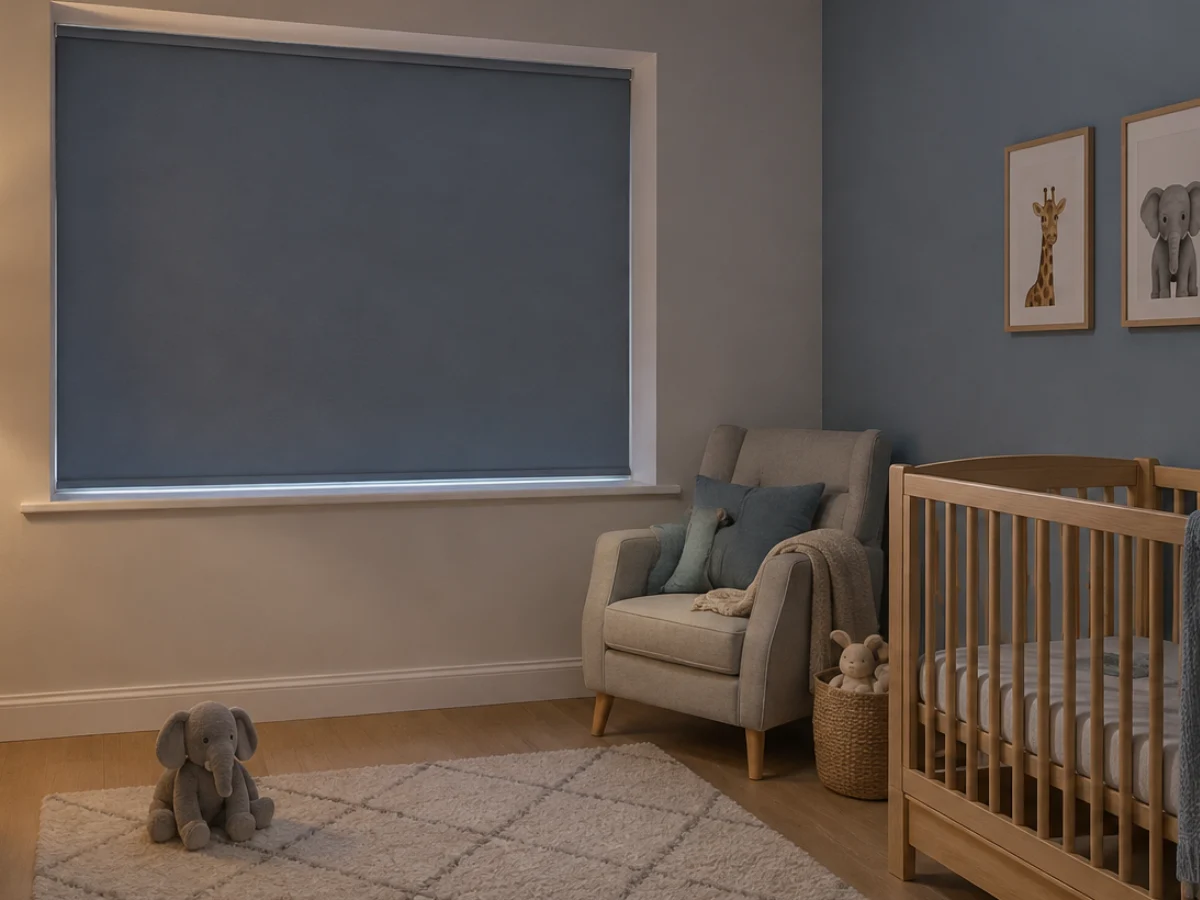
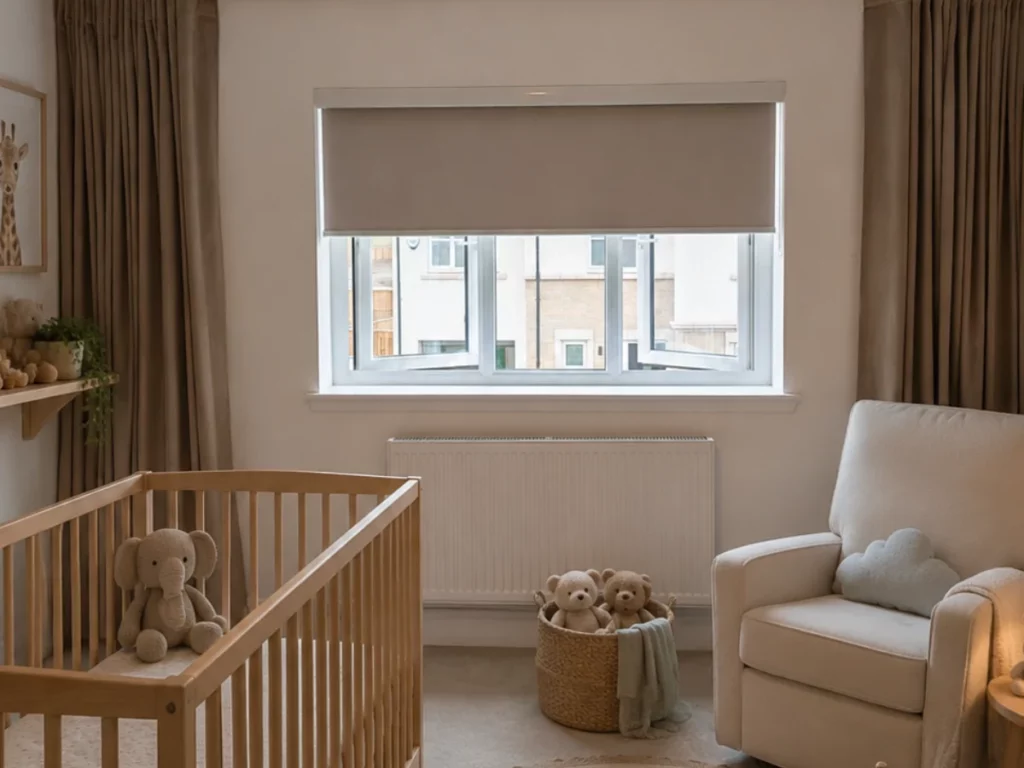
The NHS recommend keeping a nursery between 16°C and 20°C to reduce infant overheating. Our dual-cell honeycomb blackout blinds feature an inner aluminised thermal barrier that reflects solar radiation back outside in summer (reducing heat gain by up to 78%) and traps warm room air in winter to eliminate cold window drafts.

Yes. Our professional surveyors measure 3 distinct points across width and drop to account for any plaster unevenness. For shallow recesses (under 50mm depth), we supply face-mounted or slimline cassette subframes that fit flush over the architrave without impeding window handles or trickle vents.

Yes! Our smart motorized blinds connect to Apple HomeKit, Amazon Alexa, Google Assistant, or smart app routines. You can create scheduled "Nap Time" and "Bedtime" scenes that automatically lower the blind and activate your white noise machine at 1:00 PM and 7:00 PM.

Blackout blinds are not essential for every nursery, but they can help reduce early-morning light, bright summer evenings and daytime glare. This can create a darker, calmer setting for naps and bedtime routines. For the best results, choose made-to-measure blinds with minimal gaps and a cordless, child-safe operating system. Remember that blackout fabric may not provide complete darkness if light can enter around the edges.
© 2026 Cross Blinds & Shutters. All Rights Reserved. Cross Blinds & Shutters is registered in Scotland, Company No. SC704506.
Privacy Policy | Terms & Conditions
  • Keep Midges Out, Let Cool Air Flow
Maintain summer ventilation without inviting Scottish midges or wasps.

Fresh Air In.
Flies Out.

Enjoy clean breezes without the unwanted guests. Our premium Fly-Screen blinds are custom crafted to act as an invisible barrier for midges and wasps.
25% off all Blind Screen options
LIMITED INSTALLATION DIARY SLOTS
Book a free home survey and avail 25% off all Blind Screen options today!
  • Expert Fitting in Glasgow & Central Scotland
  • Proudly Scottish, Family Run Business